
AI Agents for Normal People. What I Watched, What Scared Me, and What I'm Doing About It
AI Agents for Normal People. What I Watched, What Scared Me, and What I'm Doing About It
May 27, 2026

I watched a video last week and felt two things at the same time.
Genuinely excited. And a little scared.
Not the "ooh shiny new thing" kind of excited. The kind where you watch something and think - this is actually real now. And the fear that came with it wasn't panic. It was the quiet kind. The kind that sits with you after the screen goes dark.
The video was an interview with Thibault Sottiaux, Head of ChatGPT and Codex at OpenAI. Fifty-two minutes. I watched most of it twice.
Here's where I'm sitting right now.
I'm 2.5 months into a pivot. I walked away from doing things the old way and went all-in on building systems — for my own business and for the coaches, consultants, and solopreneurs I work with. I'm in the middle of it. Still figuring things out. Still building.
So when someone at the centre of this technology sits down and says, "Agents are now reliable over long horizons — you don't need a technical background to use them. The technology matured, not the user" — I feel that differently than someone watching from the sidelines.
This is the world I just stepped into. And it is moving faster than I expected.
What agents can actually do right now.
Here's what landed hardest for me in that interview.
He walked through what he called the "Chief of Staff" workflow. You connect Gmail, Calendar, Google Docs. You tell the agent: be my chief of staff. Every morning, it gives you a summary of what matters, what meetings are coming, where your time went yesterday, and what you should probably stop doing.
No code. No technical setup. Just a few connections and a single instruction.
Then he talked about agents running on a schedule — what used to require a developer to build a cron job is now a toggle inside the app. Your agent can wake up at 6am, summarise your inbound emails, screen your prospects, pull market research, and have it waiting for you before you open your laptop.
And then the demo. He navigated to LinkedIn, exported analytics, and downloaded them into a spreadsheet. No human involved. Just the agent doing it.
That's the part that felt both amazing and scary.
The fear is real. And there's a real answer to it.
I've spoken to enough business owners to know the first question everyone asks is: "But is it safe? What if it does something I didn't want it to do?"
He addressed this directly — and it's the first time I've heard it framed in a way that actually made sense to me.
There's a second agent. A review layer. Before any action that could be risky or irreversible, a separate agent checks the first one's work and flags anything that needs your eyes. You're not handing the keys over blindly. The system is designed to keep you in control.
Start small. Give it low-stakes tasks first. Let it earn your trust the same way you'd extend trust to anyone new on your team.
The fear doesn't go away entirely — and I don't think it should. But it doesn't have to stop you from starting.
The part that changed how I think about this.
He said something near the end that I keep coming back to.
"In the future, the benefits you get will not be proportional to how good your prompting is. It will be like going to a nice tailor who instantly looks at you, gets you, and knows exactly what you need."
The skill is no longer about writing the perfect prompt. It's about showing up as yourself — clearly, consistently, authentically — and asking the right questions.
He also mentioned something practical about voice and tone. Don't try to write a document describing your communication style for the agent to follow. Just give it examples — past newsletters, recordings, messages you've actually sent. Let it learn from the real thing.
That one shifted something for me. I've been over-engineering the input. The answer is simpler: just bring your real self.
What I'm testing first.
Right now, I'm building everything inside Claude. My whole workflow is already mapped around it — and I'm not jumping ship just because something new showed up in a video.
That said, what I watched has me curious about one thing: whether it's worth eventually testing ChatGPT's agent setup side by side, just to compare how the two handle the same workflow. Maybe even experiment with some vibe coding down the line.
But not right now. I've got a system in motion and I'm not going to break it chasing the next shiny thing — which, ironically, is exactly the trap I help other people avoid.
I'm documenting everything here as I go. Not to perform progress. Because I think a lot of people in my position — mid-pivot, building in public, figuring it out — need to see someone else doing it in real time, honestly, without pretending it's all smooth.
The opportunity is real. The fear is valid. Both can be true.
If you're a coach, consultant, or solopreneur and you're not sure where to start with any of this — that's exactly what the Workflow Audit is for. We map out what you're doing manually right now, find the biggest time sinks, and figure out what's actually worth automating first. Book yours here.
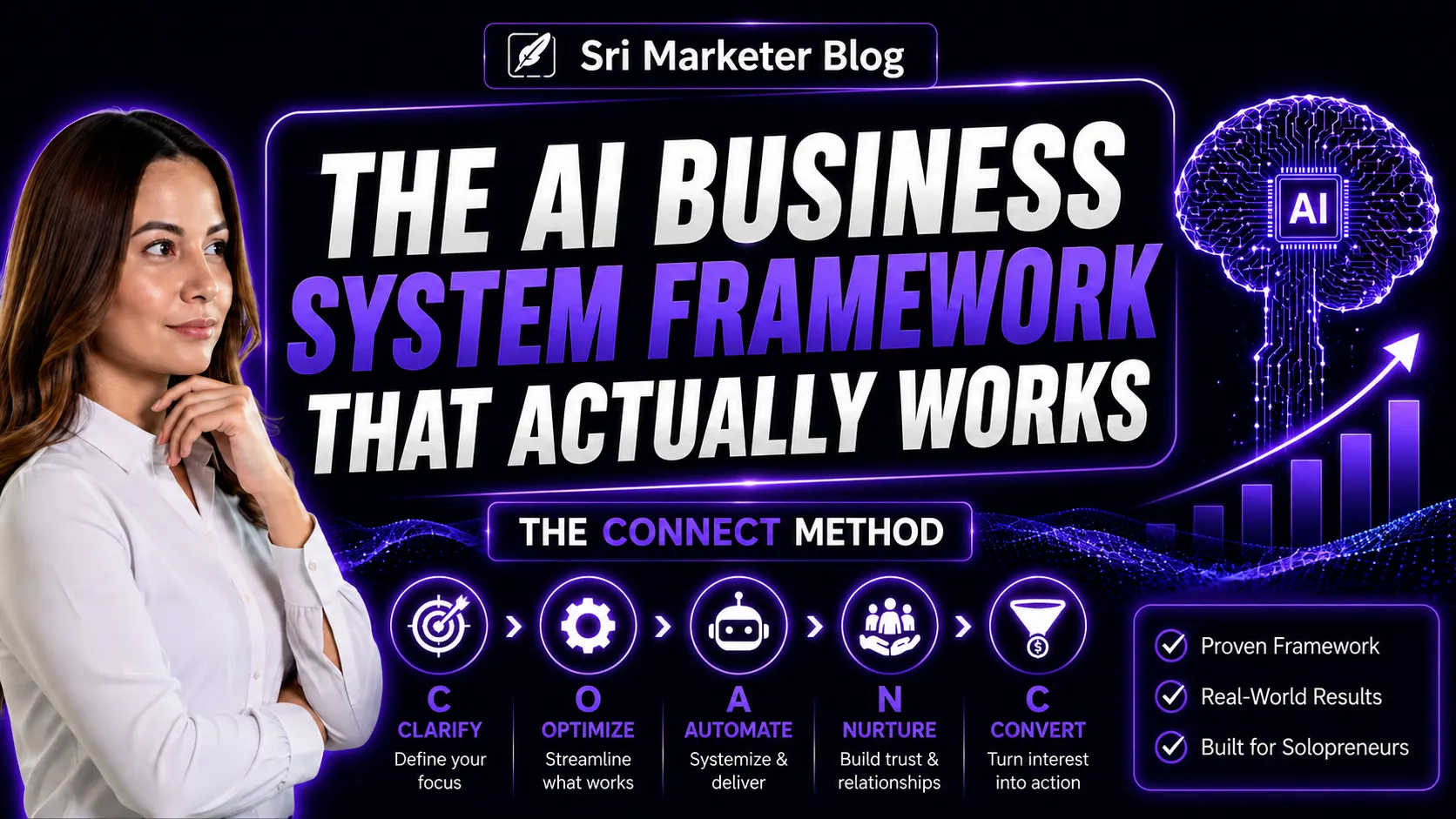
Or if you prefer to start at your own pace, the Connect Framework course at sklearningonline.com walks you through the same system I use to build and automate workflows without a technical background.
Popular Posts


















Sri Krsna Sagun
Marketing Systems Consultant & AI Strategist helping coaches, consultants & SMEs build AI-powered business systems.
Book a Free Call →