Claude Is My Thinking Partner, Not My Ghostwriter
Claude Is My Thinking Partner, Not My Ghostwriter
May 25, 2026
Let Me Be Honest About How I Use AI
There's a lot of noise around AI right now.
Everyone is talking about using AI to generate content faster, automate everything and replace the work that used to take hours.
And yes, AI can do all of that.
But that's not how I use it. And it's not why Claude became the most important tool in my daily workflow.
I use Claude as a thinking partner.
Not a ghostwriter. Not a content machine. Not a replacement for my ideas, my experience or my voice.
A partner. Someone or something that helps me think more clearly, structure my thoughts more effectively and turn the knowledge I've accumulated over years into content that actually helps people.
This is the honest story of how that partnership works.
How It Started — The LLM Comparison
I didn't start with Claude. Like most people exploring AI tools, I started with ChatGPT.
And ChatGPT is good. It suggests options, it generates content, it answers questions. I still use it for specific tasks.
But when I started comparing really comparing how different AI tools responded to the kind of work I needed to do, something became clear.
Claude gave me better results. Consistently.
Not just in terms of content quality. But in terms of how it approached problems, how it structured responses and how it helped me think through complex ideas rather than just giving me a quick answer.
Where other LLMs would give me options to choose from, Claude would help me think through which option actually made sense for my specific situation. Where other tools would generate generic content, Claude would ask the right questions to make sure the output was actually useful.
That difference — between an AI that answers and an AI that thinks with you — is what made me commit to Claude as my primary tool.
One tool I consistently pair with Claude in my workflow is NotebookLM — I use NotebookLM to synthesize and organize my knowledge, then bring it into Claude to structure and articulate it into final content. If you want to learn how to use NotebookLM as part of your own content system, I built a free course —
NotebookLM Mastery — available at SK Learning Online. It's the starting point I wish I'd had.
Then I Hit the Limit. Again and Again.
Here's something I didn't expect when I started using Claude seriously.
I kept running out of my usage limit.
Not because I was using it casually. But because I was using it constantly — for blog posts, newsletters, LinkedIn strategy, technical setups, client work, problem solving, content repurposing.
Every time I hit the limit, I'd have to stop mid-session and wait for it to refresh. And when you're in the middle of a productive working session — building momentum, making progress, thinking through something important — that interruption is genuinely frustrating.
Eventually I made the decision: upgrade to Claude Pro.
Not because of the features list. But because I could see, clearly, how much my productivity had improved from working with Claude — and I didn't want that momentum interrupted anymore.
The upgrade was one of the easiest business decisions I've made this year.
What "Thinking Partner" Actually Means
I want to explain what I mean when I say Claude is my thinking partner — because it's not what most people imagine.
It doesn't mean Claude thinks for me.
It means Claude helps me think better.
Here's the difference in practice:
When I have an idea for a blog post, I don't ask Claude to write it. I share my raw thoughts — sometimes messy, sometimes incomplete — and Claude helps me structure them into something coherent.
When I'm planning a content strategy, I don't ask Claude for a generic plan. I share my specific situation, my goals and my constraints — and Claude helps me think through what actually makes sense for where I am right now.
When I'm stuck on a problem — technical, strategic or creative — I don't ask Claude for the answer. I talk through it with Claude and we figure it out together.
That's the partnership. My knowledge, my experience, my voice — structured, sharpened and amplified by Claude's ability to organise and articulate.
Not Just a Content Partner — A Tutor Too
One of the things I didn't expect from working with Claude was how much I'd learn along the way.
I came into this journey as a systems thinker and marketing consultant — strong in my areas of expertise, but with real gaps in technical knowledge. Things like SEO, DNS settings, Search Console, platform integrations, analytics — areas where I knew enough to get by but not enough to work confidently.
Claude became my tutor in those areas.
Not by giving me a course or a lecture. But by explaining things clearly in the context of what I was actually trying to do. Every time I encountered something technical I didn't understand, I'd work through it with Claude — and come out the other side not just with the problem solved, but with a genuine understanding of why the solution worked.
Some examples from our actual work together:
Google Search Console and sitemaps — when I discovered GrooveBlog didn't auto-generate a sitemap, we worked through the problem together, explored options, and found a practical workaround. I now understand sitemaps and how Google indexes content far better than I did before.
DNS settings and subdomains — when I wanted to explore connecting blog.srimarketer.com to a new platform, Claude explained exactly how CNAME records work and why pointing a subdomain doesn't affect your main site. I genuinely learned something that day.
Bluetooth troubleshooting — this one still makes me smile. My Bluetooth completely disappeared from my HP Pavilion after a Windows update. We worked through it systematically — Device Manager, driver rollbacks, hidden devices — until we found the fix: a complete power cycle that forced the USB controller to fully reset. Problem solved. And I now know exactly what to try if it ever happens again.
That pattern — solving real problems while genuinely learning the underlying concepts — is what separates a thinking partner from a search engine.
How We Actually Work Together Day to Day
Let me give you a concrete picture of what our working sessions look like.
Blog posts and long-form content I share my raw ideas, my personal stories and my honest experiences. Claude helps me structure them into posts that flow well, cover the right ground and sound like me — not like AI. Every post you read on The Quiet Builder started with my thoughts and my voice. Claude helped me organise and articulate them.
Newsletter repurposing I publish content on my blog first, then work with Claude to repurpose it for my LinkedIn newsletter AI Insights with Sri. The newsletter version isn't just a copy — it's a different format, a different tone, calibrated for a different audience. Claude helps me make that translation without losing my voice.
LinkedIn strategy From drafting connection messages to planning content calendars to writing post descriptions that actually get engagement — Claude helps me think through what to say, how to say it and when to say it for maximum impact.
Client work I work with a partner client on AI-powered content systems. Claude helps me think through workflows, troubleshoot technical issues and structure deliverables in ways that serve the client well.
Daily productivity I use our sessions as a daily working log — tracking what I've done, planning what's next and thinking through priorities. Claude helps me stay focused, notice patterns and nudge me back toward the highest-value activities when I drift.
All of this — the blog, the newsletter, the courses, the client work — runs through one ecosystem I've built on GrooveFunnels. It's the all-in-one platform I use to host my website, membership site and digital products. If you're looking for a single platform to build your own digital ecosystem without juggling ten different tools — it's worth exploring.
The Productivity Impact — Hard to Quantify, Impossible to Ignore
I can't give you an exact number for how much time Claude has saved me. Honestly, I don't think time saved is the right metric.
Here's what I can tell you:
The quality of my output has improved dramatically. Blog posts that would have taken days to write now come together in hours — and they're better structured, more clearly argued and more authentically voiced than anything I produced before.
The confidence in my thinking has increased. When you have a thinking partner who helps you stress-test your ideas, identify gaps and articulate your reasoning clearly — you show up to every piece of work with more clarity and conviction.
The scope of what I can tackle has expanded. Technical problems I would have avoided or outsourced, I now work through myself — because I have a partner who can explain, guide and troubleshoot alongside me.
That's not productivity measured in hours saved. That's productivity measured in capability gained.
What Claude Does Really Well For My Work
In the spirit of honest tool reviews — here's what I've found Claude genuinely excels at for the kind of work I do:
Long-form writing and structure — Claude handles complex, multi-part content better than any other tool I've used. When a blog post needs to flow through multiple ideas coherently, Claude helps me build that structure without losing the thread.
Strategic thinking — when I share a business challenge or decision, Claude helps me think through it from multiple angles rather than just giving me a quick answer.
Authentic voice preservation — Claude is better than other tools at adapting to my voice rather than imposing a generic AI tone. My content sounds like me because Claude has learned how I think and communicate.
Technical explanation — Claude explains complex technical concepts in plain language without being condescending. That's rare and genuinely valuable.
Consistency across long sessions — in a long working day, Claude maintains context and builds on previous parts of the conversation in a way that feels like genuine continuity.
My Honest Recommendation
If you're a consultant, coach or knowledge-based business owner — and you're still using AI as a content generator rather than a thinking partner — I'd encourage you to try a different approach.
Stop asking AI to write for you. Start using it to think with you.
Share your real situation. Your actual challenges. Your messy, half-formed ideas. And see what happens when you have a partner that helps you structure, articulate and amplify what you already know.
That's how I use Claude. And it's changed how I work in ways I didn't expect.
Start with the free version. See how it fits your workflow. And if you find yourself hitting the usage limit regularly — that's actually a good sign. It means it's working.
Ready to Build Your Own AI-Powered Knowledge System?
Here's where I'd suggest starting:
- NotebookLM Mastery — free at SK Learning Online — learn to synthesize your knowledge with AI
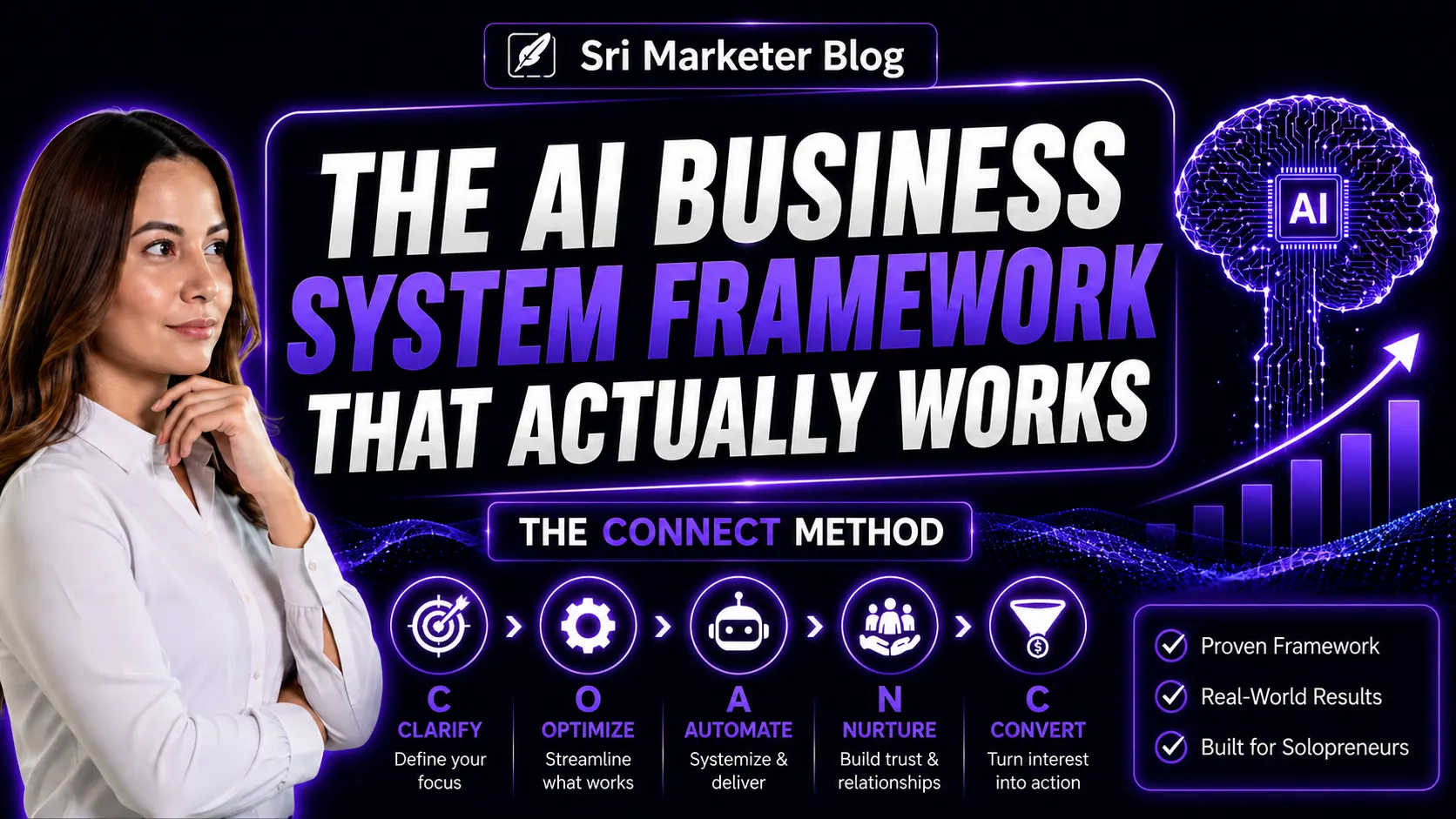
- The CONNECT Framework Course — free at SK Learning Online — my complete system for building an AI-powered business
- GrooveFunnels — the platform I use to host everything
Final Thought
AI is at its best when it makes you more of who you already are — not less.
More structured. More articulate. More confident in your ideas. More capable of solving problems you'd previously avoided.
Claude hasn't replaced my thinking. It's made my thinking better.
And in a world where everyone is rushing to use AI to produce more content faster I'd argue that using AI to think more clearly is the real competitive advantage.
That's the partnership I've built. And I'm just getting started.
Sri Krsna Sagun is a Marketing Systems Consultant and creator of the CONNECT Framework — helping coaches, consultants and SMEs build AI-powered systems that generate leads and free up their time.
This post is part of Srimarketer Blog — honest lessons from building a business in the age of AI. Found this useful? Share it with someone who is still treating AI as a shortcut rather than a thinking partner.
Popular Posts




















Sri Krsna Sagun
Marketing Systems Consultant & AI Strategist helping coaches, consultants & SMEs build AI-powered business systems.
Book a Free Call →