
How the CONNECT Framework connects content, systems, and conversion.
How the CONNECT Framework connects content, systems, and conversion.
Aug 09, 2026
Most businesses treat content, systems, and conversion as three separate problems. A content person handles the posting. A tech person handles the automation. Someone else, often nobody, is supposed to figure out why none of it turns into actual revenue.
They're not three problems. They're one chain, and most businesses are only ever looking at one link of it at a time.
Here's how the CONNECT Framework treats them as what they actually are, connected, not separate departments.
Content Without Systems Burns Out
Content strategy on its own has a predictable failure mode: it works for a few weeks, then quietly stops. Not because the ideas ran out, but because producing content from scratch, every single time, is exhausting in a way that's invisible until it isn't.
This is where content and systems actually meet. A sustainable content practice isn't a content calendar, it's a repeatable production system: one real idea, adapted into several formats, instead of five separate scrambles for something to say. That's the Optimize pillar doing its job, not a bigger content team, a system that doesn't depend on constant fresh inspiration.
Content without that system isn't a strategy. It's a countdown to burnout.
Systems Without Content Are Invisible
The opposite failure is just as common, and less talked about. A business builds excellent automation, clean workflows, a well-oiled backend, and still gets no traction, because none of it is visible to anyone who might actually buy.
Automation solves what happens after someone shows interest. It doesn't create that interest in the first place. A perfectly automated follow-up sequence is worthless if nobody enters it. This is why Automate only works downstream of real content and real visibility, it's the pillar that makes existing interest efficient, not the pillar that generates it.
Systems without content is a business quietly running in a room with no door.
Conversion Is Where the First Two Either Pay Off or Don't
Here's the part most businesses get backwards: they treat conversion as a separate skill, better copywriting, a sharper offer, a slicker sales page, disconnected from everything upstream of it.
Conversion isn't a separate skill. It's the moment where content and systems either pay off or reveal they were never actually connected. A confusing offer doesn't fail because the sales page was weak. It fails because nobody clarified what was actually being sold before writing any copy at all, which is the whole reason Clarify sits at the front of this framework, not the back.
By the time someone reaches a Brand Positioning Exercise or a real conversion moment, the actual work has usually already happened, or it hasn't, and no amount of persuasive writing fixes a positioning problem after the fact.
The Thread That Holds It Together
Here's what ties content, systems, and conversion into one chain instead of three disconnected efforts: trust, built continuously, not once.
Content earns attention. Systems make that attention efficient to act on. Conversion turns it into revenue. But none of that compounds without the thread running underneath all three, Nurture, the ongoing, unglamorous work of actually being trustworthy over time. It's the reason someone who saw your content three months ago converts today instead of forgetting you existed.
This is the part most businesses skip because it doesn't have a clean finish line. Content has a publish button. Systems have a "it's working" checkpoint. Trust just... accumulates, or it doesn't, depending on whether anyone tended to it in between.
One Chain, Not Three Departments
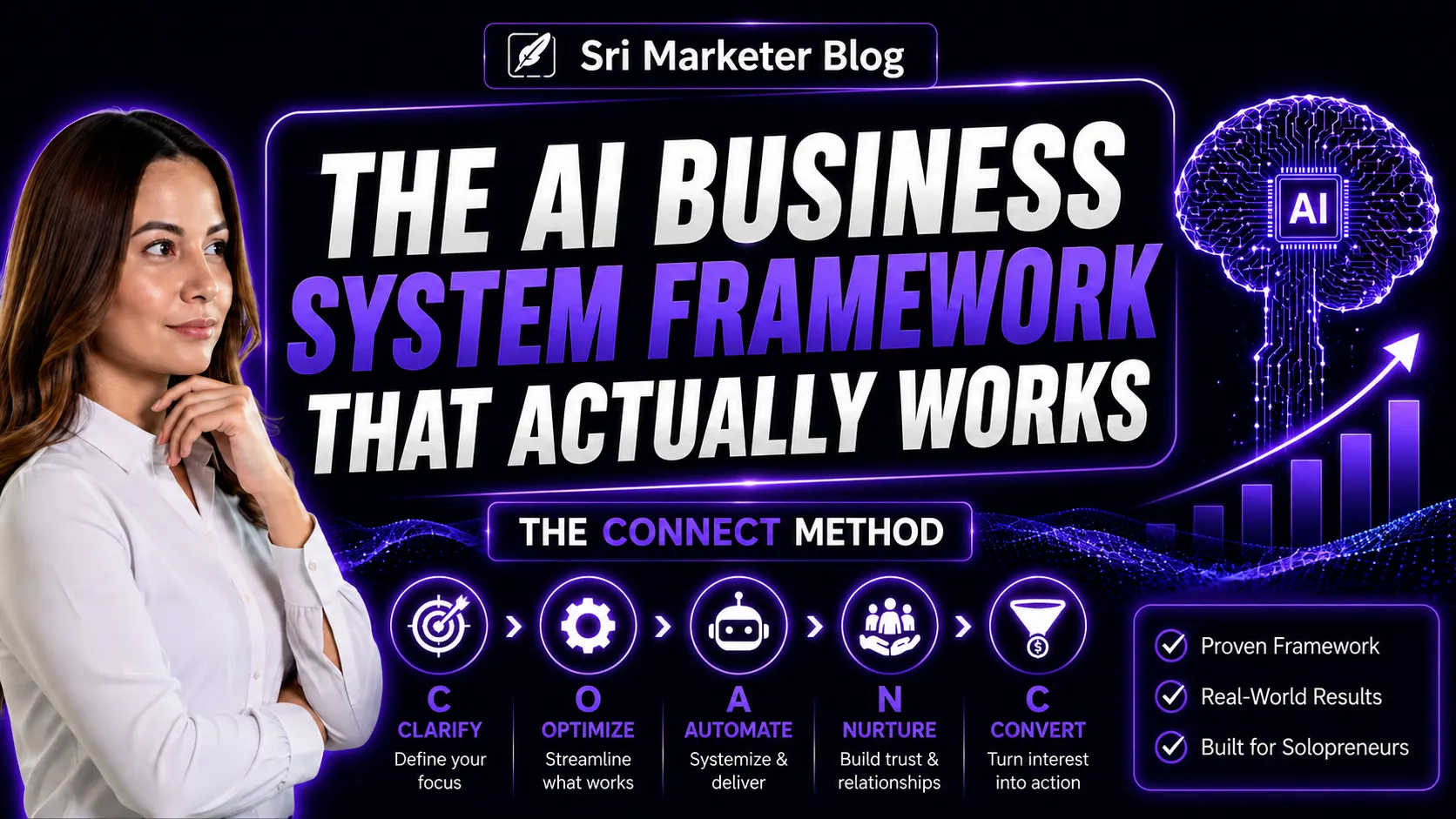
The CONNECT Framework isn't five separate services bolted together. It's one sequence: clarify what's actually true, optimize and automate so the work is sustainable, nurture the trust that makes conversion possible, then convert, because by that point, the offer has already earned its yes.
Treat any one link as its own department, and the chain breaks somewhere invisible until revenue quietly stops moving. Treat it as one connected system, and each part does less work individually, because the other parts are actually holding their end up too.
Popular Posts



























Sri Krsna Sagun
Marketing Systems Consultant & AI Strategist helping coaches, consultants & SMEs build AI-powered business systems.
Book a Free Call →