
How to build an AI marketing system without hiring a team.
How to build an AI marketing system without hiring a team.
Sep 30, 2026
Most solo business owners assume that showing up consistently, automating the busywork, and staying visible to both people and AI tools requires a team. A content person. An ops person. Someone to handle the tech.
It doesn't. What it actually requires is a system, and the right order to build it in.
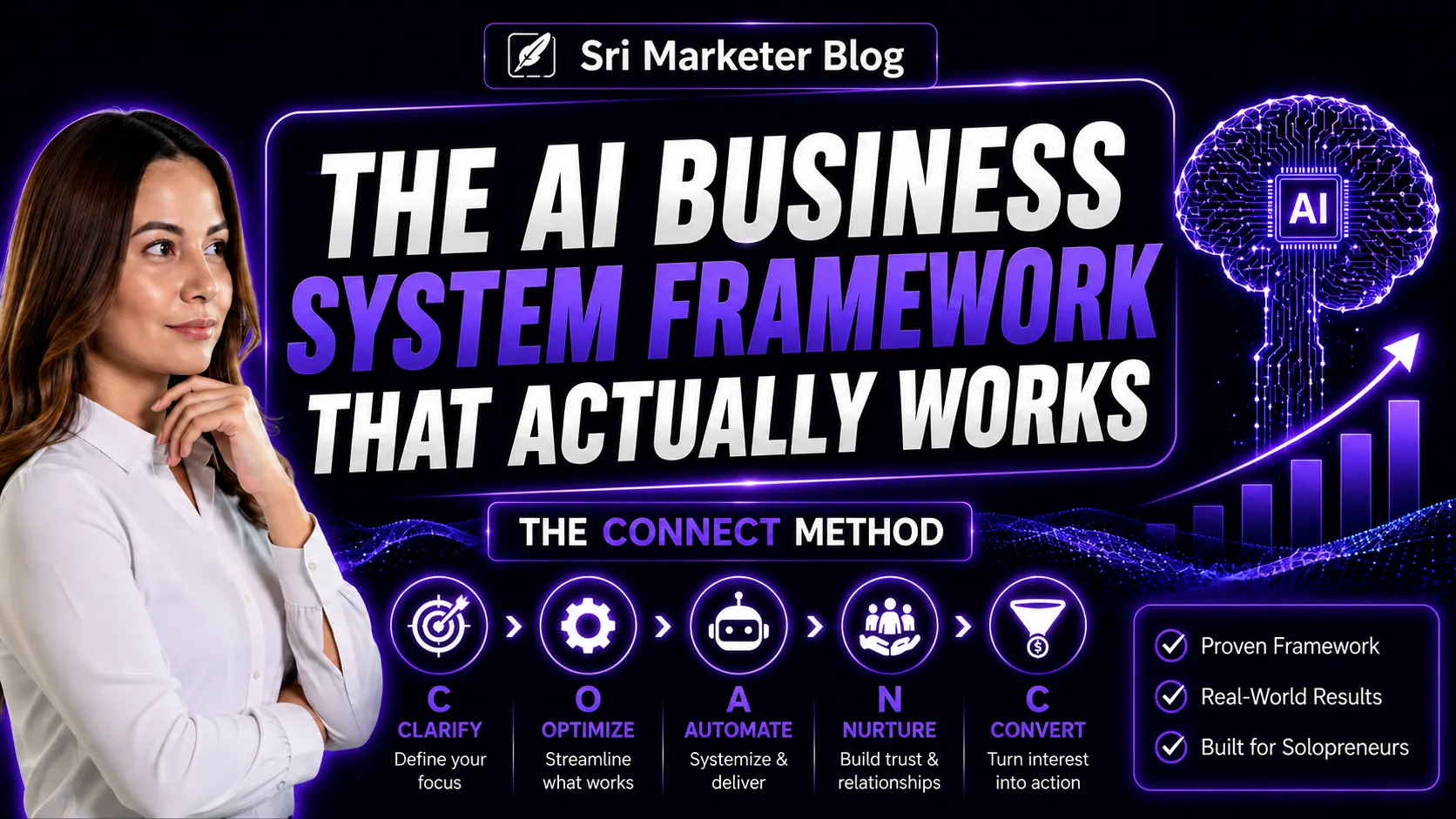
Here's how I built mine, alone, using no-code tools and a structure I now call the CONNECT Framework.
Start With Clarity, Not Tools
The instinct when you decide to "build a system" is to start shopping for tools. Resist that. The first real step is seeing what's actually happening in your business right now, what's working, what's quietly broken, what's eating time for no good reason.
I made this mistake myself early on. I collected tools before I understood what problem each one was supposed to solve. The result wasn't a system, it was a pile of subscriptions.
Before automating anything, map what you're actually doing. Where does a lead currently go after they show interest? What happens when someone books a call? What are you doing manually, every single time, that doesn't actually need a human? That mapping exercise is exactly what a Workflow Audit is built to do, if you'd rather have another set of eyes on it than guess alone.
Automate the Repetitive, Not the Creative
Once you can see the gaps, automation becomes obvious instead of overwhelming.
A concrete example from my own business: my blog had no built-in way to notify subscribers when a new post went live. Rather than doing that manually every time, or paying for a bigger platform, I connected two existing tools using their own no-code integration options, a new post gets logged, the automation catches it, and an email goes out. No one touches it.
The lesson isn't "use this specific tool." It's this: most repetitive tasks in a solo business are connection problems, moving information from one place to another, not creative problems. Those are exactly the tasks worth automating first, because they're the ones costing you time without costing you thinking. This is the exact kind of work an Automation Setup is built around.
Let AI Handle Structure, Not Your Voice
This is where most people get AI content wrong. They ask it to think for them instead of asking it to help them repeat themselves efficiently.
The system that actually works: write the deep version of an idea once, then adapt it into different formats, a long-form piece, a short post, a newsletter edition, a visual. AI is genuinely useful for the adapting, restructuring the same idea for a different reading behavior, not for generating the idea itself.
One real idea, several formats, all evergreen. That's a content system. A blank page every day chasing five different ideas is not. This is the exact system my AI Content Booster Package is built around.
Build Nurture Into the System, Not as an Afterthought
Here's the part that surprised me most: the technical side of a marketing system, on-page SEO, schema, automation, content structure, has a finish line. You fix it, you verify it, it stays fixed with occasional maintenance.
Trust doesn't work that way. Off-page SEO, showing up consistently, building real relationships, earning mentions and citations from other people, none of that has a finish line, and treating it like a task you complete once is why so many solo systems eventually go quiet.
Build the habit into the system from day one: a standing content cadence, a genuine practice of engaging with other people's work, not just publishing your own. If you'd rather have ongoing oversight on this than manage it entirely alone, that's what CONNECT Advisory exists for.
You Don't Need to Code to Build This
Every piece of this, the automation, the content pipeline, the schema and structure work, was built without writing a single line of code. No-code platforms have gotten genuinely capable. What they require isn't a developer, it's someone willing to think clearly about the actual problem before reaching for a tool.
That's the real skill behind an AI marketing system built solo: not technical ability, systems thinking. Knowing what needs to connect to what, and why, before you touch a single integration.
Where to Start
If you're building this alone, start with the part that feels least glamorous: mapping what's actually happening in your business right now. Everything else, the automation, the content system, the nurture habit, gets genuinely easier once that's clear.
You don't need a team to build this. You need the right order, and the willingness to fix the boring problem before the exciting one.
Popular Posts
























Sri Krsna Sagun
Marketing Systems Consultant & AI Strategist helping coaches, consultants & SMEs build AI-powered business systems.
Book a Free Call →