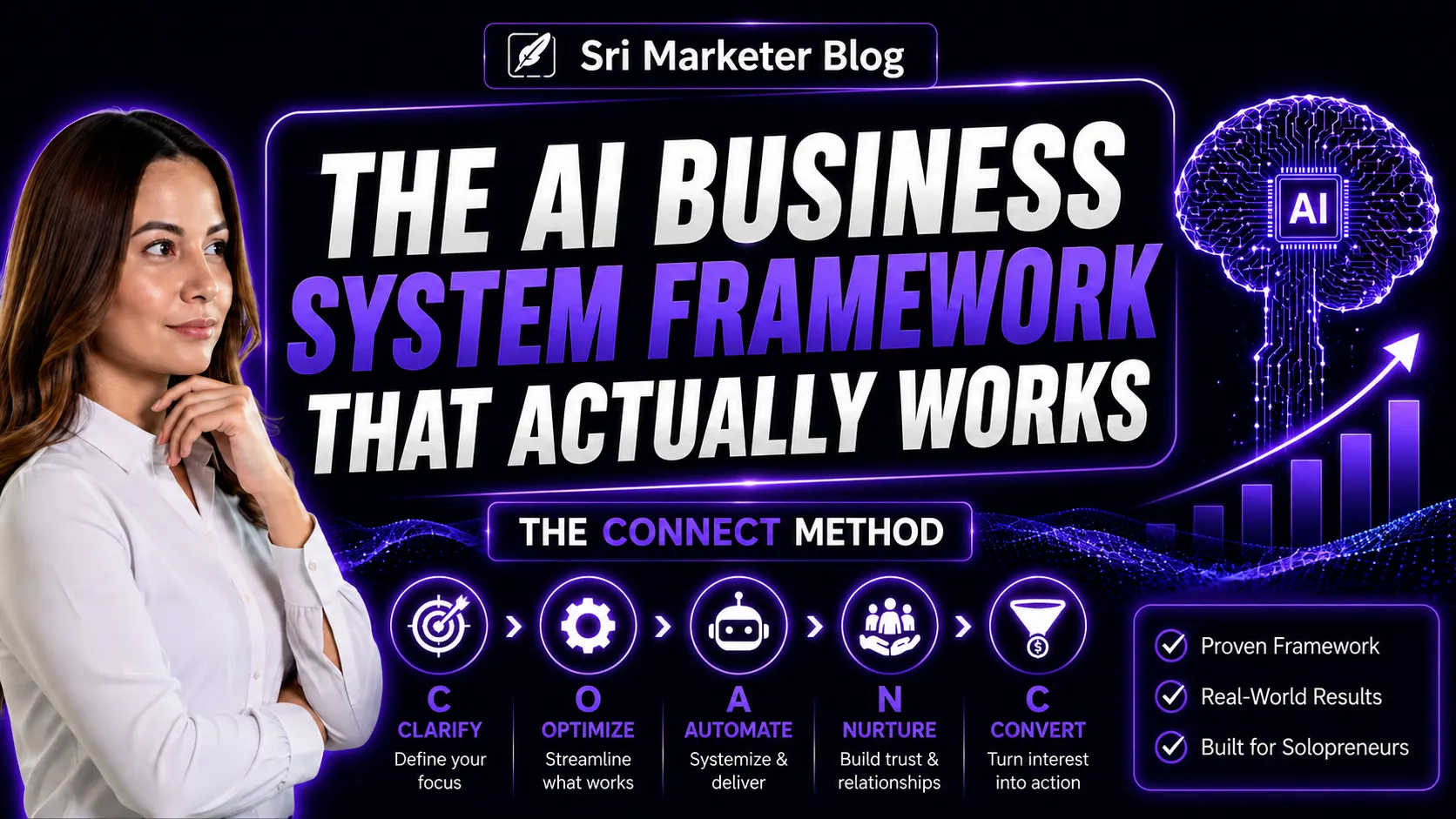
The AI Business System Framework That Actually Works for Growing Businesses(The CONNECT Framework)
The AI Business System Framework That Actually Works for Growing Businesses(The CONNECT Framework)
Jul 22, 2026
If you've ever felt like your business runs on memory instead of systems — sticky notes, half-finished automations, content you post when you remember to — you don't have a marketing problem. You have a scattered-pieces problem.
I built the CONNECT Framework to solve that in my own business before I ever offered it to a single client. It's not a theory I read about. It's the actual five-part structure behind how I run marketing, content, and operations as a one-person business — and it's built specifically for the AI era, where tools multiply faster than most people can figure out how to use them well.
Here's the full breakdown, with real examples from my own business at each step.
C — Clarify
Define your unique value proposition so the right people recognize you instantly, and the wrong ones self-select out.
Most businesses try to appeal to everyone. The result is a message that connects with no one — generic enough to apply to any business, specific enough to inspire nobody.
Clarify starts with an uncomfortable question: who exactly is this for, and what do you want to actually be known for — not what sounds impressive on a slide.
Example 1: When I rebuilt my own positioning, Clarify meant cutting my service list from six offers down to three — Workflow Audit, Automation Setup, and AI Content System — so my message stopped competing with itself.
Example 2: Clarify also meant being explicit about who I don't serve well. I work with solo founders, consultants, coaches, and SMEs — not large enterprises. Saying that out loud, publicly, filters out mismatched leads before a single call happens.
O — Optimize
Streamline your content and workflows to focus only on what actually moves the needle — and cut or delegate everything else.
This is the audit step. Before you build anything new, you need an honest picture of where your time and effort are actually going, versus where you think they're going.
Example 1: A Workflow Audit is Optimize in practice — mapping a client's current tools and daily processes, then producing a written report showing exactly where time is being lost and what to do about it, before any automation gets built on top.
Example 2: In my own business, Optimize meant realizing I was spending hours designing polished LinkedIn graphics that got 57 impressions, while a plain-text post about industry news got over 1,200. That data changed how I spend my content time entirely.
N — Nurture
Build real trust through consistent, valuable engagement — turning an audience into relationships, not just a follower count.
Nurture is the long game. It's showing up reliably with something useful, so that when someone is finally ready to buy, you're already the obvious choice.
Example 1: My weekly newsletter, AI Insights with Sri, exists purely as a Nurture mechanism — no hard pitch, just consistent, honest insight into what's actually working (and not working) in AI-powered business.
Example 2: This blog itself is a Nurture asset — documenting real wins, real mistakes, and real numbers as they happen, rather than polished case studies written after the fact.
A — Automate
Set up systems for the repetitive work so your time goes toward what only you can do.
This is where AI tools genuinely earn their keep — not by replacing your judgment, but by removing the manual grind around it.
Example 1: Automation Setup — the client-facing version of this pillar — typically covers follow-ups, scheduling, lead capture, and content distribution, built with tools like Zapier, Calendly, or ActiveCampaign depending on what a client already uses.
Example 2: In my own operations, a Telegram bot delivers me a daily morning summary automatically, and a Zapier automation logs every new blog post to a tracking sheet the moment it publishes — zero manual entry required.
C — Convert
Turn interest into action with clear offers and an obvious next step — closing the gap between engagement and actual revenue.
A lot of businesses do Clarify, Optimize, Nurture, and Automate reasonably well, then lose the sale because there's no clear, low-friction way to say "yes."
Example 1: Every service page ends with one clear action — a 30-minute call — not five competing options that create decision fatigue.
Example 2: Convert also means following up. A lead who engaged with your content three months ago isn't dead — they're often just waiting for the right, well-timed nudge.
Why This Matters More Now Than Ever
AI tools make it easier than ever to produce content, automate tasks, and look productive. But tools without a framework just create noise faster. The CONNECT Framework isn't about adopting more AI — it's the structure that makes the AI you already have actually useful, instead of one more thing competing for your attention.
Ready to see where your business stands?
Popular Posts























Sri Krsna Sagun
Marketing Systems Consultant & AI Strategist helping coaches, consultants & SMEs build AI-powered business systems.
Book a Free Call →