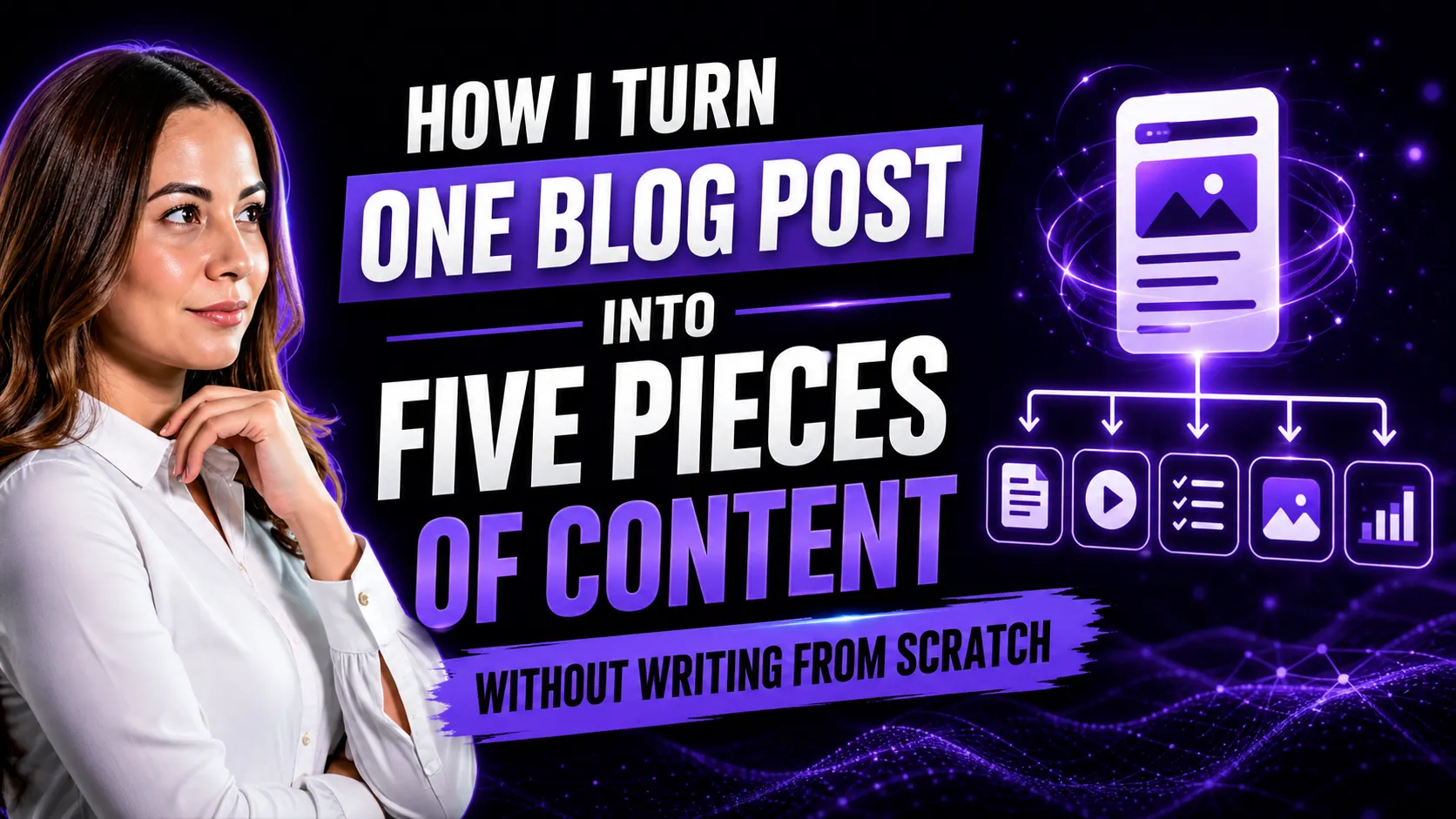
How I Turn One Blog Post Into Five Pieces of Content Without Writing From Scratch
How I Turn One Blog Post Into Five Pieces of Content Without Writing From Scratch
Sep 29, 2026
For a long time, content felt like a treadmill. Every platform wanted something new. LinkedIn wanted posts. My newsletter needed an edition every week. My blog needed articles. And every time I sat down, I started from a blank page.
That's what burned me out. Not the writing. The starting over.
So I stopped treating each platform as a separate job. Now I write one core piece and let it become many. Here's exactly how that works in my business.
Start with one strong piece
Everything begins with a blog post. It's where I go deepest on an idea, share my real experience, and explain the "why" behind it.
I start here for a simple reason. A blog post is the most complete version of the idea. It's much easier to shorten something than to stretch it. Once the full thinking is on the page, every other format becomes an editing job, not a writing job.
It's also the piece that lives on my own website, where search engines and AI tools can find it. Social posts come and go. The blog stays.
Turn it into five formats
From that one post, I create:
- A LinkedIn Article. Similar depth, but reworded so it isn't a copy of the blog. It speaks more directly to business owners scrolling LinkedIn.
- A LinkedIn feed post. A short version with one main idea and a question at the end to start a conversation.
- A newsletter edition for AI Insights with Sri. More personal, like writing to a friend, and it always links back to the full blog post.
- A video or reel. The key message, spoken or shown in under a minute.
- A carousel for TikTok and Instagram. One idea per slide, built to be swiped and saved.
Each format has a different job. The blog explains. The feed post starts a conversation. The newsletter builds a relationship. The carousel reaches people who've never heard of me.
How AI helps without taking over
This is the part people usually ask about.
I use Claude, set up as two assistants with separate jobs.
My research assistant helps me dig into a topic first. It helps me gather information, check what's accurate, and figure out the angle before anything gets written.
My writer assistant then drafts each format one at a time: the blog post, the LinkedIn Article, the feed post, the newsletter, and the carousel. Keeping research and writing separate means each draft starts from solid thinking instead of a guess.
Keeping the labels separate stopped me from getting confused about what I'd already repurposed and what was still waiting. Every piece has its own lane.
But here's the part I never skip. I review every single draft before it goes anywhere. I check if it sounds like me. I check if every claim is true. I remove anything that overstates what I've actually done.
AI gives me the first version. The final version is still mine. I wrote more about this in Claude Is My Thinking Partner, Not My Ghostwriter.
Don't post everything at once
When I first started repurposing, I wanted to publish all five pieces the same day. That was a mistake.
Now I space them out. The newsletter goes first. The blog follows a few days later. The LinkedIn post comes after that, and the carousel after that. One idea turns into a small series that shows up across a couple of weeks instead of one busy day.
This does two things. People who see the idea on one platform get reminded of it on another. And I always have something ready to post, even on weeks when I don't have time to create anything new.
Fix the system before adding tools
If you want to try this, don't start by buying a new AI tool. Start by deciding what your one core piece will be, and which platforms actually matter to your audience.
A tool can speed up a system. It can't replace having one. I explain why in Why Fixing Your Workflow Has to Come Before Buying Any AI Tool.
Try it with one post
Pick one piece of content you've already written. A blog post, a long LinkedIn post, even a newsletter.
Ask yourself: what's the one-line version? What's the conversation starter? What would this look like as five slides?
You'll probably find you have more content than you thought. It's just sitting in one place.
If you'd like help setting up a content system like this for your business, that's exactly what my AI Content System service is built for.
Popular Posts














Sri Krsna Sagun
Marketing Systems Consultant & AI Strategist helping coaches, consultants & SMEs build AI-powered business systems.
Book a Free Call →